Oracle Global Navigation
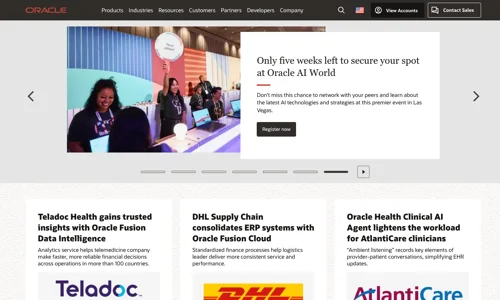
I led the evolution of Oracle’s shared global navigation into a reusable front-end platform that could support dozens of navigation implementations across a large international web ecosystem, with accessibility, localization, performance, and design flexibility built into the core.
Oracle needed more than a single navigation component. It needed a durable system that could adapt to different brands, logos, icons, themes, content models, and site requirements across many properties without collapsing into one-off implementations or fragile forks.
Scale / ownership
What the system had to support and what I owned
Scale and scope
Oracle’s global navigation was not a page-level component. It had to work across multiple web properties, support deep and changing information architecture, localize across 34 languages, and remain accessible as business, brand, and platform needs continued to evolve.
Over time, I built dozens of navigation implementations at Oracle. Each one had to accommodate different mixes of content, logos, icons, themes, layouts, and site constraints while still behaving like part of the same coherent system. That meant the real challenge was not just building navigation. It was building a flexible platform that could absorb variation without losing consistency, accessibility, or maintainability.
Ownership and approach
I was the sole front-end engineer on the shared navigation through six generations of the system. The work spanned implementation, accessibility, responsive behavior, testing, rollout, and the less visible system stewardship that keeps a shared component from fragmenting as more teams and use cases adopt it.
I built the navigation inside a shared component library so teams could control content, branding, and site-specific configuration without forking the underlying interaction patterns. That required designing APIs and component boundaries that were flexible enough for real-world variation, but constrained enough to protect consistency across a large platform.
A big part of the role was translating evolving design and business requirements into reusable patterns. Instead of solving each new navigation need as a custom build, I worked to identify the underlying system need and fold it back into the shared architecture. That made the component library stronger over time and reduced the long-term cost of change.
The navigation was feature-rich and DOM-heavy, so on a platform handling roughly 95 million monthly page views on oracle.com alone, I treated delivery as an architectural concern rather than an implementation detail. This let me reduce initial page cost while keeping the complete interaction model intact.
Business and engineering impact
At this scale, navigation bugs do not stay local. Accessibility issues, focus regressions, weak customization patterns, or design drift can spread quickly. Building the shared implementation the right way created a stronger foundation for consistency, rollout safety, and future change.
The result was a navigation system that could support broad variation without turning into dozens of disconnected solutions. It helped Oracle maintain a more consistent experience across 9 sites, 34 languages, and 76 countries, including acquired properties and changing brand surfaces, while giving teams the flexibility they needed within a shared system.
Impact
What changed for the product and the teams
- Sole front-end engineer responsible for six generations of Oracle’s shared navigation system.
- Built dozens of navigation implementations that adapted to different content structures, logos, icons, themes, and site-level needs without rewriting the core system.
- Created the navigation as a reusable library component with configurable structure, branding, and behavior, and turned evolving brand and UX requirements into durable shared patterns instead of one-off solutions.
- Owned the interaction model end to end, including accessibility, responsive behavior, keyboard and focus management, testing, rollout strategy, long-term maintainability, and reducing initial render cost by loading the large navigation DOM only when needed.