My Portfolio
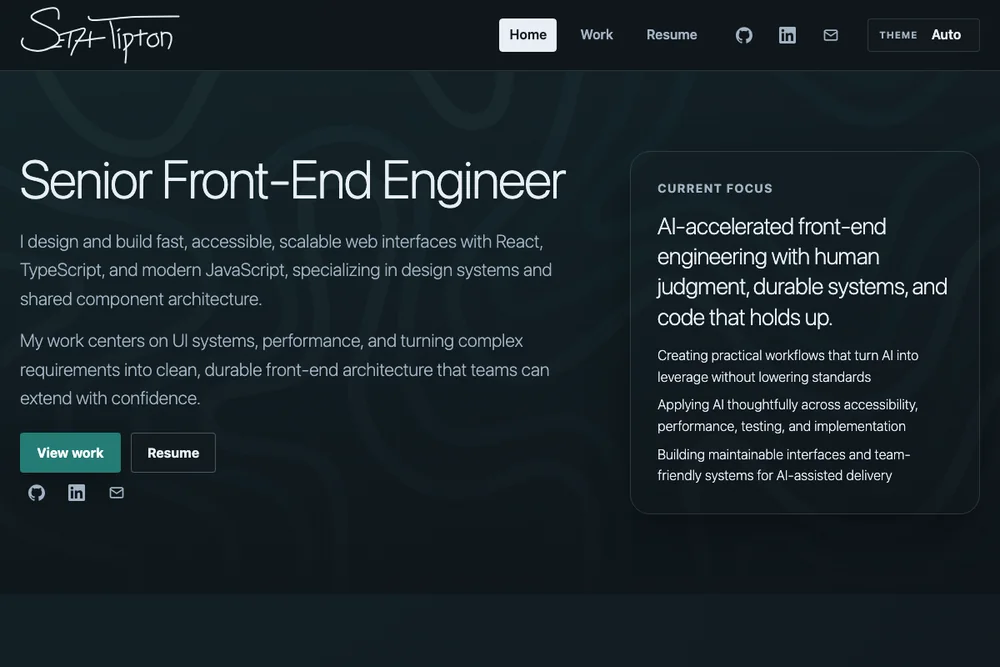
Built this site as a structured Astro publishing system for case studies, resume content, and front-end experiments, with a static-first setup that stays fast and easy to maintain.
The challenge was to make the site feel editorially controlled and technically sharp without turning a personal portfolio into a heavier application than it needed to be.
Scale / ownership
What the system had to support and what I owned
Scale and scope
I created the site to do more than list projects. It had to support longer case studies, structured resume content, and ongoing iteration without becoming a pile of one-off pages.
Because it also acts as a front-end sample, the implementation mattered as much as the content. It needed to feel intentional, load quickly, and stay easy to maintain.
Ownership and approach
I built the site end to end in Astro, partly as a showcase and partly as a practical way to learn the framework. The main goal was to create a structured publishing setup instead of a collection of loosely connected pages.
I used shared data schemas, reusable layouts, and a clear split between content and templates so the site could stay consistent as it grew. Token-driven styling keeps the visual system flexible, and Astro content collections make it easy to update case studies and resume data across multiple views without duplicating structure.
Client-side behavior stays intentionally narrow. The baseline remains static-first, with targeted enhancements such as the theme explorer layered in where they add clear value without changing the overall performance.
Business and engineering impact
A portfolio should reflect the same level of judgment it talks about. For me, that meant building something fast, maintainable, and structured enough to evolve cleanly. Treating it like a publishing system instead of a one-off marketing page makes it a better representation of how I approach front-end work.
Impact
What changed for the product and the teams
- Built the site end to end in Astro with shared content models across the homepage, work archive, case studies, and resume.
- Kept content and templates separate so visual or structural changes do not require reworking the entire site.
- Structured case studies and resume content around shared schemas, reducing duplication across multiple views and outputs.
- Added focused client-side behavior like theme persistence, SVG motion, and view transitions without giving up the static-first baseline.